About this guide: Murgado Lincoln of Chicago serves Lincoln owners throughout Chicago and the surrounding area from our location at 2501 N Elston Ave. This guide reflects general seasonal maintenance considerations along with practical points commonly discussed with Chicago-area Lincoln owners. Specific inspection results, vehicle specifications, part condition, and recommended service depend on the individual vehicle, model year, mileage, and equipment.
Four areas are worth checking before Chicago's first freeze: the 12-volt battery, the cooling system, the tires, and the AWD or 4x4 system where equipped. Cold temperatures reduce a battery's ability to deliver starting power, so a marginal battery may become more noticeable once winter arrives. Coolant condition and concentration affect freeze protection. Tire pressure typically decreases as temperatures fall, while tread condition plays an important role in snow and slush traction. And although AWD or 4x4 can help a vehicle gain traction while accelerating, neither replaces the importance of appropriate tires when braking and cornering.
Call our service department at 888-369-4620 to schedule a pre-winter inspection, or keep reading for a closer look at what each check involves.
This guide explains how cold weather can affect these systems, what a pre-winter inspection may include, how winter preparation can differ across Corsair, Nautilus, Aviator, and Navigator models, and what owners of Lincoln plug-in hybrid models should keep in mind as temperatures fall.
Why Chicago Winters Are Hard on a Vehicle's Systems
Chicago winters can combine prolonged periods below freezing, occasional sub-zero temperatures, road salt and other deicing materials, and frequent temperature changes. These conditions can expose components that were already approaching the end of their useful service life, including an aging battery, worn tires, or a cooling system that is not maintaining the correct coolant concentration.
These effects are not unique to Lincoln vehicles. They apply broadly to vehicles driven in cold climates. The goal of a pre-winter inspection is to identify condition-related concerns before colder weather makes them more noticeable or potentially more inconvenient.
Battery: Why Cold Weather Can Expose a Weak Battery
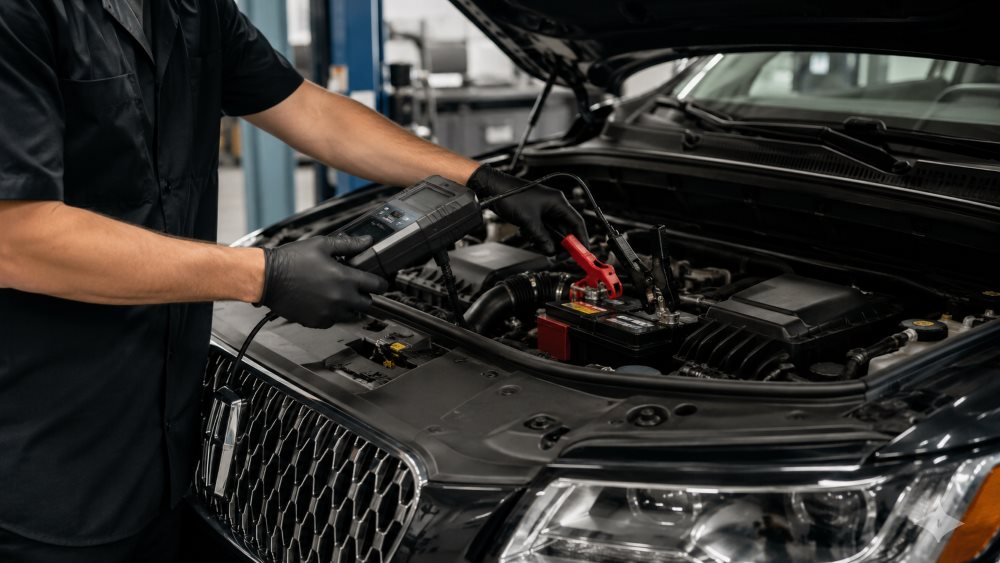
A 12-volt battery's ability to deliver starting current decreases as temperatures fall. At the same time, cold temperatures can increase the amount of effort required to start a conventional gasoline engine. A battery that performs normally during warmer weather may therefore show signs of weakness once temperatures drop.
A battery test can help assess whether the battery is delivering adequate performance rather than relying only on its resting voltage. If testing indicates that the battery remains healthy, replacement may not be necessary. If performance has deteriorated, the results can help determine whether additional diagnosis or replacement should be considered before winter.
Plug-in hybrid Lincoln models also use a 12-volt electrical system even though propulsion is supported by a high-voltage battery and electric motor system. On Corsair Grand Touring plug-in hybrid models, and on earlier Aviator Grand Touring PHEV models, the condition of the 12-volt battery therefore remains relevant to normal vehicle operation.
Cold weather can also temporarily affect available electric driving range and charging performance on electrified vehicles. Actual performance varies with temperature, driving conditions, climate-control use, battery state of charge, and the individual vehicle.
Coolant: Confirming Freeze Protection and the Correct Specification
Engine coolant serves several functions, including transferring heat and providing freeze protection when the correct coolant and concentration are used. If the coolant mixture becomes excessively diluted or an incorrect fluid has been added, its ability to provide the intended level of freeze and corrosion protection can be affected.
Lincoln vehicles have model- and model-year-specific coolant requirements. A pre-winter cooling-system check can include evaluating coolant condition and freeze protection and confirming that the fluid meets the specification listed for the individual vehicle.
Avoid choosing coolant solely by color or assuming that any universal coolant is appropriate. The applicable specification should be confirmed using the owner's manual or other manufacturer information for the specific vehicle.
Cold weather can also make some existing cooling-system problems more noticeable, including leaks associated with aging hoses, seals, connections, or other components. If you've noticed a coolant warning, unusual coolant odor, visible residue, or a change in coolant level, having the system inspected can help identify the cause.
Tires: Pressure, Tread, and Whether Winter Tires Make Sense
Tire pressure changes with temperature, which means tires that were properly inflated during warmer weather can show lower pressure after a significant temperature drop. This is one reason tire-pressure warnings are often noticed during seasonal changes.
Check and adjust cold tire pressure according to the vehicle manufacturer's specification shown on the tire information label or door-jamb placard. Do not use the maximum pressure molded into the tire sidewall as the vehicle's recommended inflation pressure.
Tread condition also becomes especially important in winter. Deeper, properly maintained tread helps a tire manage water, snow, and slush. A tire can remain above the legal minimum tread depth while providing substantially less snow and slush traction than a comparable tire with deeper tread.
Whether dedicated winter tires make sense depends on your driving conditions and priorities. Quality all-season tires in good condition may meet the needs of many drivers who primarily use plowed and treated Chicago streets and expressways. Drivers who regularly encounter snow-covered or less-maintained roads may benefit from dedicated winter tires.
Winter tires are specifically designed for low-temperature operation and winter conditions, using tread patterns and rubber compounds intended to provide improved traction in cold weather, snow, and ice compared with conventional all-season tires.
AWD and 4x4: What They Do and Don't Do in Winter
All-wheel-drive and four-wheel-drive systems can improve traction when power is being delivered to the wheels, particularly when accelerating from a stop or driving on a low-traction surface. Their operation and capabilities vary by vehicle.
What AWD or 4x4 does not eliminate is the importance of tire grip. Braking and cornering depend heavily on the contact between the tires and the road surface. A vehicle with AWD or 4x4 can still have limited braking or cornering traction when its tires cannot maintain adequate grip.
This is why drivetrain configuration and tire condition should be considered together rather than treating AWD or 4x4 as a substitute for appropriate tires and cautious winter driving.
A pre-winter inspection can also be a reasonable opportunity to investigate drivetrain warning messages, unusual noises, vibration, or other symptoms if they are present.
Lincoln drivetrain configurations vary by model, model year, and trim. Depending on the vehicle, Lincoln SUVs may use Intelligent All-Wheel Drive or a 4x4 system. If you're unsure how your Lincoln is equipped, the drivetrain configuration can be confirmed using the vehicle's specifications or VIN-specific information.
Winter Prep by Lincoln Model
Lincoln Corsair
Tire condition, tire pressure, battery condition, coolant protection, and drivetrain operation are all useful areas to review before winter on a Corsair.
Corsair Grand Touring models use a plug-in hybrid powertrain. Owners should also keep in mind that cold temperatures can temporarily affect electric range and charging performance, while the 12-volt electrical system remains an important part of vehicle operation.
Lincoln Nautilus
Nautilus drivetrain and powertrain specifications vary by model year. Recent Nautilus models use Intelligent All-Wheel Drive, including both conventional gasoline and available hybrid configurations. Owners of earlier vehicles should confirm the equipment and maintenance requirements applicable to their specific model year and trim.
Lincoln Aviator
Depending on model year and equipment, Aviator models may use rear-wheel drive or Intelligent All-Wheel Drive. Confirm your vehicle's configuration rather than assuming every Aviator uses the same drivetrain.
Earlier Aviator Grand Touring models used a plug-in hybrid powertrain. For those vehicles, winter preparation should include the same tire, coolant, and 12-volt battery considerations discussed above, along with attention to the electrified powertrain if warning messages or performance concerns are present.
Lincoln Navigator
Navigator uses a 4x4 drivetrain configuration on equipped models rather than the Intelligent AWD terminology used on several other Lincoln SUVs. Configuration and available drive settings can vary by model year and wheelbase.
Because tire sizes, pressures, and load requirements vary by vehicle and equipment, use the tire information label on your specific Navigator when checking inflation rather than assuming the specification matches another Lincoln model.
Dealer vs. Independent Shop: When Each May Make Sense for Winter Prep
Many routine winter-preparation checks can be performed by a qualified independent repair facility, tire shop, or dealership. The appropriate choice depends largely on the type of service or diagnosis required.
A qualified independent shop or tire facility may be suitable for: tire-pressure adjustments, tread inspections, conventional battery testing, and general visual inspections of common maintenance components.
A Lincoln dealer service center may be particularly useful for: diagnosing Lincoln-specific drivetrain warning messages or electronic concerns, confirming manufacturer specifications for a particular model and model year, diagnosing hybrid or high-voltage systems, performing applicable recall or service-program work, and diagnosing or repairing systems that may be covered by an active Lincoln factory or CPO warranty.
Service performed outside a Lincoln dealership does not automatically determine warranty eligibility. Warranty coverage depends on the applicable warranty terms, the condition being repaired, and the circumstances of the individual claim.
At Murgado Lincoln of Chicago, our service team can evaluate the battery, cooling system, tires, and drivetrain-related concerns during the same service visit when those inspections are requested and applicable to the vehicle.
What Can Affect the Cost of Winter Preparation?
The cost of winter preparation depends on what the inspection finds and whether any maintenance or repairs are actually needed. A vehicle whose battery, coolant, and tires are all in good condition may require little beyond routine inspection and adjustment, while another vehicle may need a battery, tires, cooling-system service, or additional diagnosis.
Rather than relying on a general estimate that may not reflect your specific vehicle, ask for an estimate based on the vehicle, requested services, and inspection findings.
Call our service department at 888-369-4620 or visit our current service offers page to review available offers and applicable terms before scheduling.
Frequently Asked Questions
How cold does it need to get before I should worry about my battery?
There isn't a single temperature at which every battery becomes unreliable. Battery age, condition, state of charge, vehicle use, and temperature all influence performance. Testing the battery before winter can provide more useful information than waiting for starting problems to appear.
Do I need winter tires if my Lincoln has AWD or 4x4?
AWD or 4x4 and winter tires address different aspects of winter driving. The drivetrain can help distribute power when accelerating, while the tires provide the road contact needed for acceleration, braking, and cornering. Whether dedicated winter tires make sense depends on the conditions in which you typically drive and the condition and type of tires currently installed.
Why did my tire-pressure warning light come on when it got cold?
Tire pressure generally decreases as temperatures fall. A tire that was correctly inflated during warmer weather can therefore drop below the vehicle's recommended pressure after a significant temperature change. Check cold tire pressure against the specification on the vehicle's tire information label or door-jamb placard and adjust as appropriate.
Does cold weather affect a Lincoln plug-in hybrid's electric range?
Yes. Cold temperatures can temporarily reduce available electric driving range and can affect charging performance on plug-in hybrid and electric vehicles generally. Actual results vary based on temperature, climate-control use, driving conditions, battery state of charge, and the individual vehicle.
How often should coolant be checked or changed?
Coolant maintenance requirements depend on the specific Lincoln model, model year, engine, and coolant specification. Follow the maintenance information and fluid specification provided for your individual vehicle. A pre-winter inspection can also be an opportunity to evaluate coolant condition and freeze protection when appropriate.
Can I do a pre-winter inspection myself?
Some basic checks can be performed by owners, including checking tire pressure, looking for visible tire damage, and reviewing fluid levels according to the owner's manual.
Battery performance testing, coolant freeze-protection testing, electronic drivetrain diagnosis, and hybrid high-voltage system diagnosis generally require appropriate equipment and should be performed by someone familiar with the applicable procedures and safety requirements.
Is it too early or too late to schedule winter preparation?
Having the vehicle checked before sustained freezing weather arrives can provide time to address maintenance or repair needs before colder conditions. Winter-related inspections can still be useful later in the season, particularly if you've noticed a warning message, starting difficulty, tire-pressure issue, coolant concern, or drivetrain symptom.
Schedule Your Lincoln Winter Prep Inspection in Chicago
Whether you want the 12-volt battery tested, coolant freeze protection checked, tires inspected, or a drivetrain concern evaluated before winter, Murgado Lincoln of Chicago can help you determine which services are appropriate for your specific vehicle.
Service Department: 888-369-4620
Schedule Service Online | Current Service Offers
Vehicle specifications, maintenance requirements, inspection results, recommended service, parts needed, and pricing vary by vehicle and are not guaranteed by this guide. Service offers, eligibility requirements, exclusions, and expiration dates may change; review current offer terms before scheduling. Always follow the maintenance schedule, fluid specifications, tire-pressure information, and other instructions applicable to your specific vehicle.
About Murgado Lincoln of Chicago Service Center
Murgado Lincoln of Chicago is located at 2501 N Elston Ave and serves Lincoln owners throughout Chicago and the surrounding area. Our service department supports Lincoln Corsair, Nautilus, Aviator, and Navigator vehicles, including applicable hybrid and plug-in hybrid models.
This guide provides general seasonal maintenance information and is intended for educational purposes. Vehicle specifications, inspection results, maintenance requirements, and recommended service depend on the individual vehicle. Published 2026-08-18 · Last reviewed 2026-08-18.